
International Symposium
Physical Biology of Multicellular Dynamics
March 12 - 13, 2026
MIRAICHI Research Center, Kanazawa University
OVERVIEW
Outline
Multicellular dynamics— key process by which the functions and forms of tissues, organs, and entire organisms are shaped— have long been, and continue to be, one of the central focuses for researchers working at the intersection of biology and physics. This symposium aims to highlight recent advances in understanding various aspects of such multicellular dynamics through the lens of physics, covering topics such as cell-cell interactions, morphogenesis, tissue organization, and multiscale cell mechanics.
Organizers
Tetsuya Hiraiwa (Institute of Physics, Academia Sinica)
Satoru Okuda (Nano Life Science Institute, Kanazawa Univ.)
Satoru Okuda (Nano Life Science Institute, Kanazawa Univ.)
Date & Time
March 12, 2026, 9:30 AM – March 13, 2026, 1:30 PM
Venue
MIRAICHI Research Center, 3rd Floor
Kanazawa University
Kakuma-machi, Kanazawa, Ishikawa 920-1192, Japan
► See the access
Kanazawa University
Kakuma-machi, Kanazawa, Ishikawa 920-1192, Japan
► See the access
Language
English
Registration Fee
Free of charge
Acknowledgments


PROGRAM
Speakers
- Chen-Hui Chen (Institute of Cellular and Organismic Biology, Academia Sinica)
- Antoine Diez (RIKEN Center for Interdisciplinary Theoretical and Mathematical Sciences)
- Natalie Dye (Mechanobiology Institute, National University of Singapore)
- Takeshi Fukuma (Nano Life Science Institute, Kanazawa University)
- Chin-lin Guo (Institute of Physics, Academia Sinica)
- Sayuki Hirano (Graduate School of Biostudies, Kyoto University)
- Tsuyoshi Hirashima (Mechanobiology Institute, National University of Singapore)
- Fumio Motegi (Institute for Genetic Medicine, Hokkaido University)
- Shizue Ohsawa (Graduate School of Science, Nagoya University)
- Alice Tsuboi (RIKEN Center for Biosystems Dynamics Research)
- Hiroyuki Uechi (Graduate School of Pharmaceutical Sciences, Kyoto University)
- Yu-Chiun Wang (RIKEN Center for Biosystems Dynamics Research)
- Tetsuya Hiraiwa (Institute of Physics, Academia Sinica)
- Satoru Okuda (Nano Life Science Institute, Kanazawa University)
Time Table
| Time | Speakers |
| 08:45 - 13:30 | Venue opens |
| 09:00 - 13:30 | Registration opens |
| 09:30 - 10:40 (Chair: Tsuyoshi Hirashima) | Opening Remarks: Satoru Okuda |
| Satoru Okuda, Nano LSI, Kanazawa Univ. Elastoplastic transition and mechanical feedback during epithelial morphogenesis | |
| Alice Tsuboi, RIKEN BDR Instructive roles of the extracellular matrix in buckling-based tissue morphogenesis | |
| Coffee Break | |
| 11:00 - 12:10 (Chair: Alice Tsuboi) | Shizue Ohsawa, Graduate School of Science, Nagoya Univ. Non-autonomous ECM disassembly drives the epithelial shape transition of the Drosophila wing discs |
| Natalie Dye, Mechanobiology Institute, NUS 3D morphogenesis of the Drosophila wing disc | |
| Lunch Break & Poster Viewing | |
| 13:10 - 14:20 (Chair: Natalie Dye) | Chen-Hui Chen, ICOB, Academia Sinica What can we learn from monitoring every single cell in a living fish? |
| Fumio Motegi, IGM, Hokkaido Univ. Cooperative induction of oogenesis via cytoplasmic suction from developing oocytes | |
| Coffee Break | |
| 14:40 - 15:50 (Chair: Chen-Hui Chen) | Yu-Chiun Wang, RIKEN BDR Morphogenetic arms race: how might mechanics influences evolution |
| Sayuki Hirano, Graduate School of Biostudies, Kyoto Univ. Dynamic redistribution of adhesion-related molecules tunes collective cell behavior | |
| Coffee Break | |
| 16:10 - 17:20 (Chair: Sayuki Hirano) | Hiroyuki Uechi, Graduate School of Pharmaceutical Sciences, Kyoto Univ. Sidekick condensation ensures protein accumulation to tricellular junctions for epithelial remodeling |
| Takeshi Fukuma, Nano LSI, Kanazawa Univ. Visualizing nanoscale dynamics and mechanics in living cells by nanoendoscopy AFM | |
| Break | |
| 17:30 - 20:30 (Chair: Tetsuya Hiraiwa) | Poster Session & Banquet Welcome Remarks: Takeshi Fukuma, Nano LSI, Kanazawa Univ. Welcome Remarks: Fumio Motegi, IGM, Hokkaido Univ. |
| Time | Speakers |
| 09:00 - 13:30 | Venue opens |
| 09:30 - 10:40 (Chair: Hiroyuki Uechi) | Chin-lin Guo, Institute of Physics, Academia Sinica Creating Scaffold-Free Mimetic Environments within Scaffolds to Scale Up Cell Self-Organization |
| Tsuyoshi Hirashima, Mechanobiology Institute, NUS Waves, order, and flow emerging from mechanochemical coupling in active epithelia | |
| Coffee Break & Poster Viewing | |
| 11:10 - 12:20 (Chair: Chin-lin Guo) | Antoine Diez, RIKEN iTHEMS Self-organized mechano-chemical instabilities drive the emergence of tissue morphogenesis in digit organoids |
| Tetsuya Hiraiwa, Institute of Physics, Academia Sinica In silico study of morphogenesis of dynamic cell assemblies | |
| 12:20 - 12:25 | Closing Remarks: Tetsuya Hiraiwa |
| 12:25 - 13:30 | Lunch with Free Discussion (Posters off the boards) |
| 13:30 - 14:30 | Tour of NanoLSI (Registration required) |
POSTER SESSION
Poster Session Information
Maximum poster size: Up to 170 cm (H) × 120 cm (W)
(e.g., A0 portrait, 841 mm × 1189 mm)
Mounting time: By lunchtime on Day 1
Presentation time (author attendance): TBA
(e.g., A0 portrait, 841 mm × 1189 mm)
Mounting time: By lunchtime on Day 1
Presentation time (author attendance): TBA
Poster List (tentative)
| No. | Name | Affiliation | Title |
| 01 | Abhinandan Angra | RIKEN BDR | Spontaneous Symmetry Breaking in Confined Actomyosin |
| 02 | Alexis Borowiak | Kanazawa Univ. | Ferroelectric Cell Culture Substrates: A Biomechanical Study |
| 03 | Chan Chung Wing | Kyoto Univ. | Active Polar Swarms in Heterogeneous Alignment Fields: Theory, Simulation, and Experiment |
| 04 | Basnayake Kavindu Deshan | Kanazawa Univ. | Development of Phthalocyanine-Based Photothermal Dyes for Localized Heating at the Plasma Membrane |
| 05 | Nada Dougui | RIKEN BDR | The Importance of Spectrin in Epithelial Apical Dome Maintenance and Dorsal Fold Initiation |
| 06 | Dam Truyen Duc | Nagoya Univ. | How Chirality Stabilizes Dense Active Matter |
| 07 | Hironobu Fujiwara | RIKEN BDR | Molecular and biophysical insights into basement membrane remodelling in mammalian epithelial morphogenesis |
| 08 | Shuya Fukamachi | Kanazawa Univ. | Mechanical instability inherent in foam geometry induces epithelial stratification |
| 09 | Kana Furukawa | UOsaka | Elucidating the Principles of Tracheal Tissue Formation Driven by Epithelial–Mesenchymal Mechanical Interactions |
| 10 | Jun Hatakeyama | Kumamoto Univ. | Direct Measurement of Intraventricular Pressure in Developing Mouse Embryos |
| 11 | Masayoshi Hayashi | Nagoya Univ. | Myoblast Migration and Epithelial Morphological Changes Regulated by Basement Membrane ECM Dynamics |
| 12 | Lisna Hidayati | NAIST | Predicting Single-Cell Movement from Surrounding Cells' ERK Activity Using Machine Learning during Wound Healing |
| 13 | Hiroshi Hosoi | Nagoya Univ. | Deciphering the Mechanisms of Epithelial Deformation in the Drosophila Wing Imaginal Disc |
| 14 | Kohji Hotta | Keio Univ. | Residual Tail Twisting in Ascidian Larvae Is Stabilized by Asymmetric Myofibrils Against Bilateral Symmetry Restoration |
| 15 | Ryunosuke Karimata | Kanazawa Univ. | An antiparallel cell circulation driven by self-aligned tension gradient |
| 16 | Li CuiCui | Kanazawa Univ. | Observation of the calcium wave that propagates the developing Drosophila compound during cellular mechanical interaction |
| 17 | Anshuman Mishra | RIKEN BDR | Exploration of a mechanosensitive link between tissue-scale mechanical instabilities and subcellular remodeling of epithelial polarity during Drosophila dorsal fold formation |
| 18 | Nguyen Thi Nhu Y | Kanazawa Univ. | Fluorescence lifetime–based biosensor for quantifying temperature in living cells |
| 19 | Rena Ogawa | Keio Univ. | Live Imaging Analysis of Mesenchymal Cells during Ascidian Metamorphosis |
| 20 | Phan Minh Tri | Kanazawa Univ. | A red color fluorescence lifetime-based ATP biosensors working at 37 ℃ |
| 21 | Ren Weichao | Kanazawa Univ. | Dynamics of the radial actin fibers in the developing Drosophila compound eye during cellular mechanical interaction |
| 22 | Yuichi Sakumura | NAIST | Machine Learning Analysis of Determinants of Endothelial Cell Migration Direction in Angiogenesis |
| 23 | Makoto Sato | Kanazawa Univ. | More Than Just Hexagons: Does an Einstein Tile Exist in Life? |
| 24 | Tatsuo Shibata | RIKEN BDR | Collective chiral behaviors of multicellular systems |
| 25 | Aska Sonoki | Shiseido Co., LTD. | Low-Level Compressive Force Reorganizes Collagen Fiber Orientation and Enhances Dermal Strength |
| 26 | Aki Teranishi | Kanazawa Univ. | Mechanosensitive Elastoplastic Transition in Epithelial Folding Ensures Unidirectional Morphogenesis |
| 27 | Chayanit Thiticharoentam | Kanazawa Univ. | Computational Design of Epithelial Architectures via Modulation of Cell–Cell Interfacial Tension in a 3D Vertex Model |
| 28 | Hisaaki Tsutsumi | NIBB | Comparative Proteomics of the Endometrial Apical Surface to Identify Essential Factors for Successful Implantation |
| 29 | Valentina Tyukosova | Kanazawa Univ. | A divergent pattern of long-term cell shape and motility arising from a tensile gradient of a nonconservative fluid membrane |
BANQUET
Banquet
Date & Time: March 12, from 6:00 PM
Venue: Same location as the symposium
Fee: 4,000 yen (registration required; via the registration form)
Venue: Same location as the symposium
Fee: 4,000 yen (registration required; via the registration form)
REGISTRATION
How to Register
Please register using the following form.
► Registration Form
Registration Deadline
Closed
Registration Fee
Free of charge
VENUE
Lunch
Fee: 1,000 yen for each day (registration required; via the registration form)
- There are only a limited number of places nearby to have lunch, so we recommend ordering a lunch box through the registration form.
- The cost of the lunch box will be advanced by the conference, and therefore no changes can be made after registration.
Accomodation
Participants are kindly requested to arrange their own accommodation.
As there are few hotels near the venue, we recommend staying in the downtown "Korinbo" area, such as:
As there are few hotels near the venue, we recommend staying in the downtown "Korinbo" area, such as:
Wi-Fi
eduroam is available throughout the venue.
Please set up eduroam with your home institution in advance. For configuration instructions, refer to your institution's guide.
Please set up eduroam with your home institution in advance. For configuration instructions, refer to your institution's guide.
ACCESS
Access
The venue, Kanazawa University Kakuma Campus, is located a bit away from the train station and downtown area. Transportation by bus or taxi is required.
MIRAICHI Research Center, Kanazawa University
Kakuma-machi, Kanazawa, Ishikawa 920-1192, Japan
Kakuma-machi, Kanazawa, Ishikawa 920-1192, Japan
Komatsu Airport ⇔ Kanazawa Station (by Bus)
- Duration & Fee: approx. 55 min, 1,300 yen
- Take the Hokuriku Railway Limousine Bus running between Komatsu Airport.
- Get off at Kanazawa Station (West Gate).
Kanazawa Station / Korinbo (Downtown) ⇔ MIRAICHI Research Center (by Taxi)
- Duration & Fee: approx. 25 minutes, approx. 3,500 yen
- From Station: Take a taxi from the "Kenrokuen-guchi (East Gate)" taxi stand.
- From Korinbo: Take a taxi from a nearby taxi stand or on the street.
- Tell the driver: "Kanazawa University, Kakuma Campus, MIRAICHI Research Center".
If not understood, please say: "Nano Life Science Institute (ナノ生命科学研究所)" or "Cancer Research Institute (がん進展制御研究所)".
Kanazawa Station ⇔ Kanazawa University Kakuma Campus (by Bus)
- Duration & Fee: approx. 32 minutes, 380 yen
- From Station: Take bus No. 93, 94, or 97 bound for "Kanazawa University (Kakuma Campus)" from "Kenrokuen-guchi (East Gate) Bus Terminal" (Bus Stop No. 8). Get off at "Kanazawa University Institute of Natural Science".
- Return trip: From the same stop ("Kanazawa University Institute of Natural Science"), take bus No. 93, 94, or 97 back to Kanazawa Station.
Korinbo (Downtown) ⇔ Kanazawa University Kakuma Campus (by Bus)
- Duration & Fee: approx. 22 minutes, 380 yen
- From Korinbo: Take bus No. 93, 94, 96, or 97 bound for "Kanazawa University (Kakuma Campus)" from "Shiko Kinenkan-mae" (四高記念館前, in front of Ishikawa Shiko Memorial Park) (Bus Stop No. 1). Get off at "Kanazawa University Institute of Natural Science".
- Return trip: From the same stop ("Kanazawa University Institute of Natural Science"), take bus No. 93, 94, 96, or 97 back to Korinbo.
Note: Kanazawa University Kakuma Campus is different from Kanazawa University Hospital. Please be sure to head to the Kakuma Campus (Institute of Natural Science area), not the hospital.
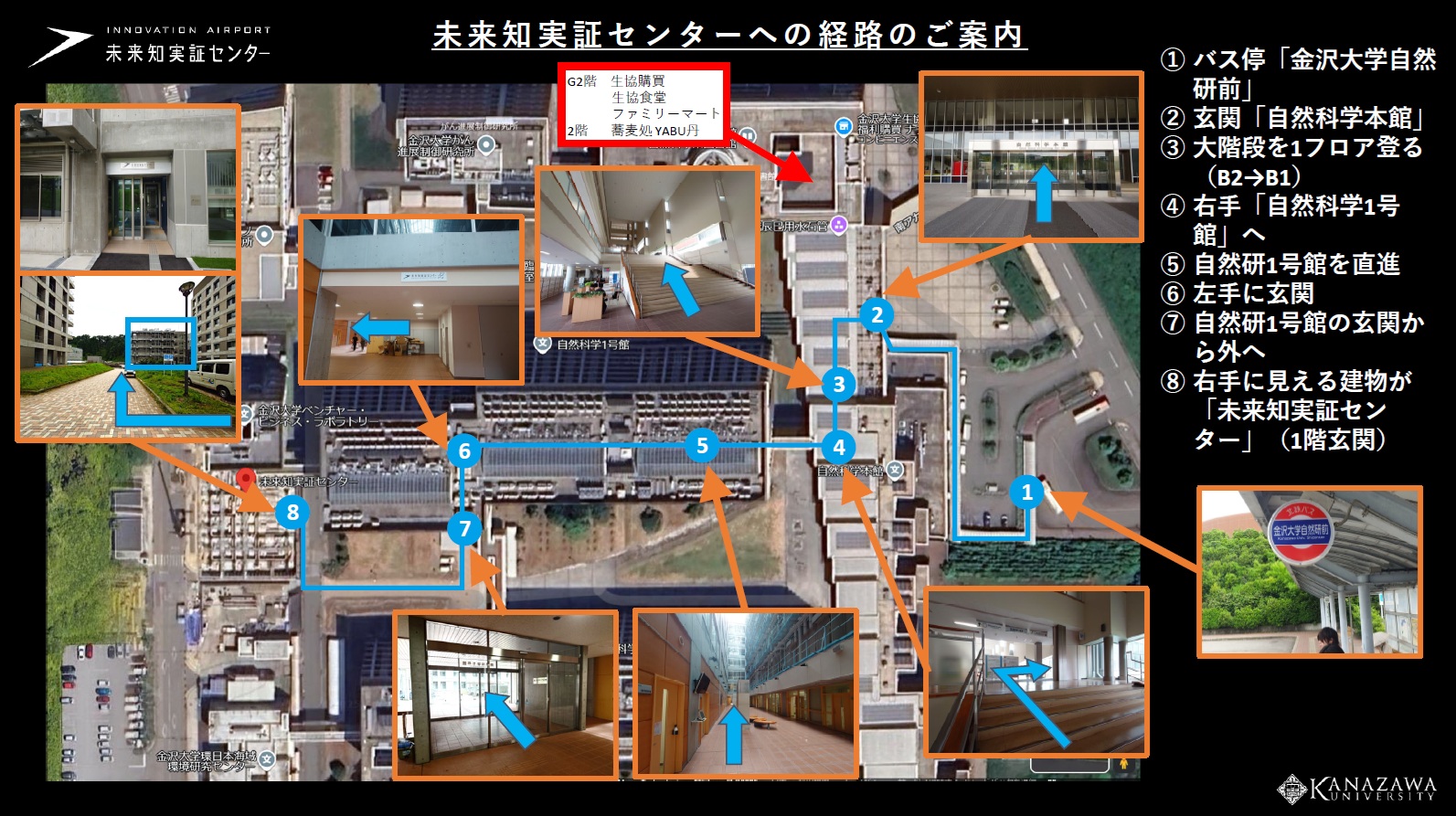
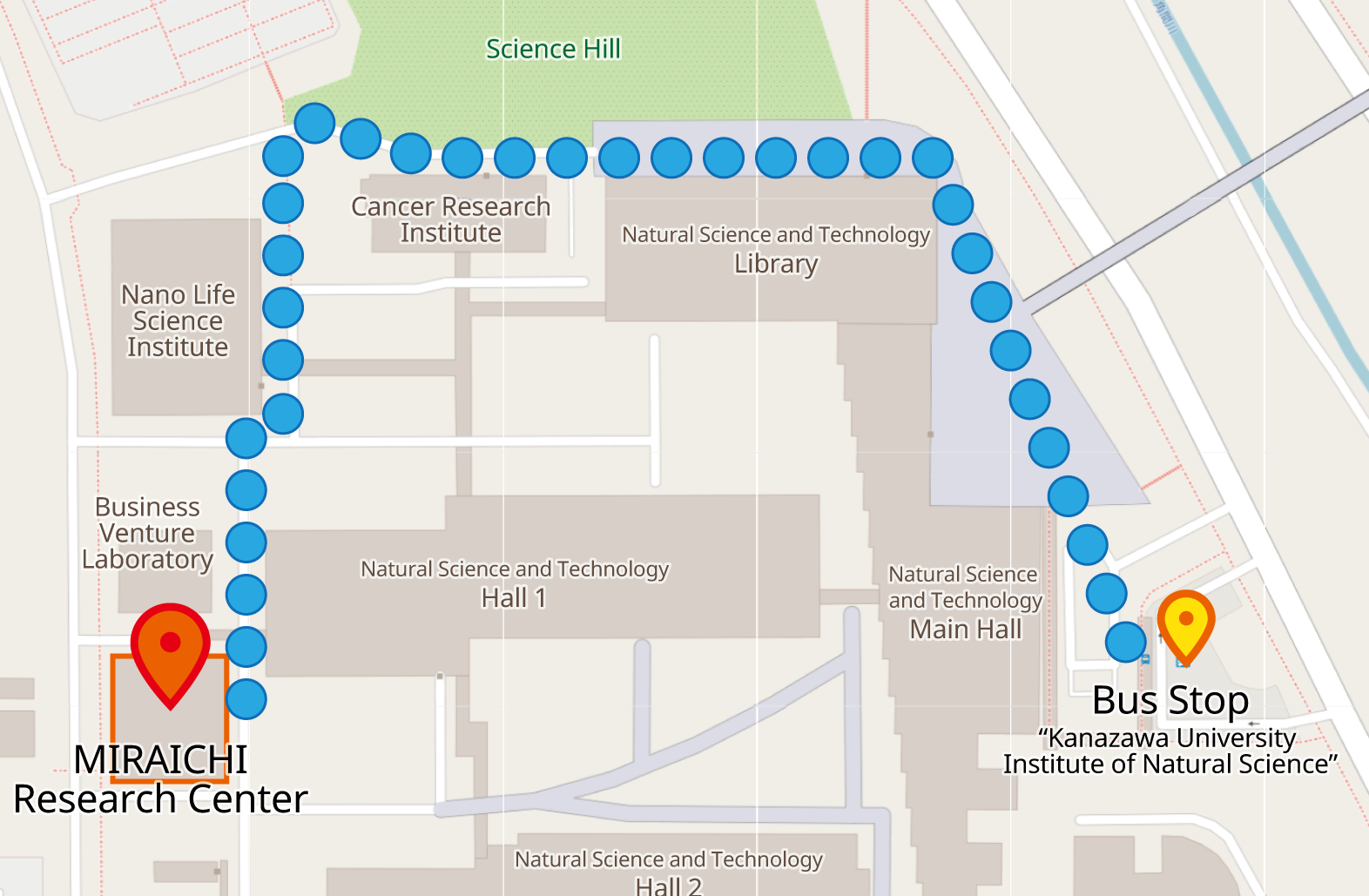
Bus Station ⇔ MIRAICHI Research Center (by Walk)
- Duration: less than 10 min
・Pass outside
CONTACT
Contact
Please use the form below to contact us.
► Contact Form
► Contact Form